

Nobody sits down and designs a security stack from scratch. Stacks grow over time, usually driven by more endpoints, more identities, and whatever risk feels most urgent.
Endpoints became a target, so you bought antivirus, then EDR. Phishing took off, so an email gateway went in. Credentials became the easiest way in, so identity protection came next. Workloads moved to SaaS and the cloud, and another tool followed. Somewhere along the way, a SIEM showed up to make sense of all of it.
Every one of those decisions was reasonable. Each tool solved the problem in front of it at the time. And when contracts came up for renewal, most teams extended them, because ripping out a working tool mid-year is disruptive, expensive, and hard to justify when nothing is visibly on fire.
The result is a stack that reflects the history of your risk, one surface at a time. What it was never built to do is follow an attack from one surface to the next.
Attacks move along a path
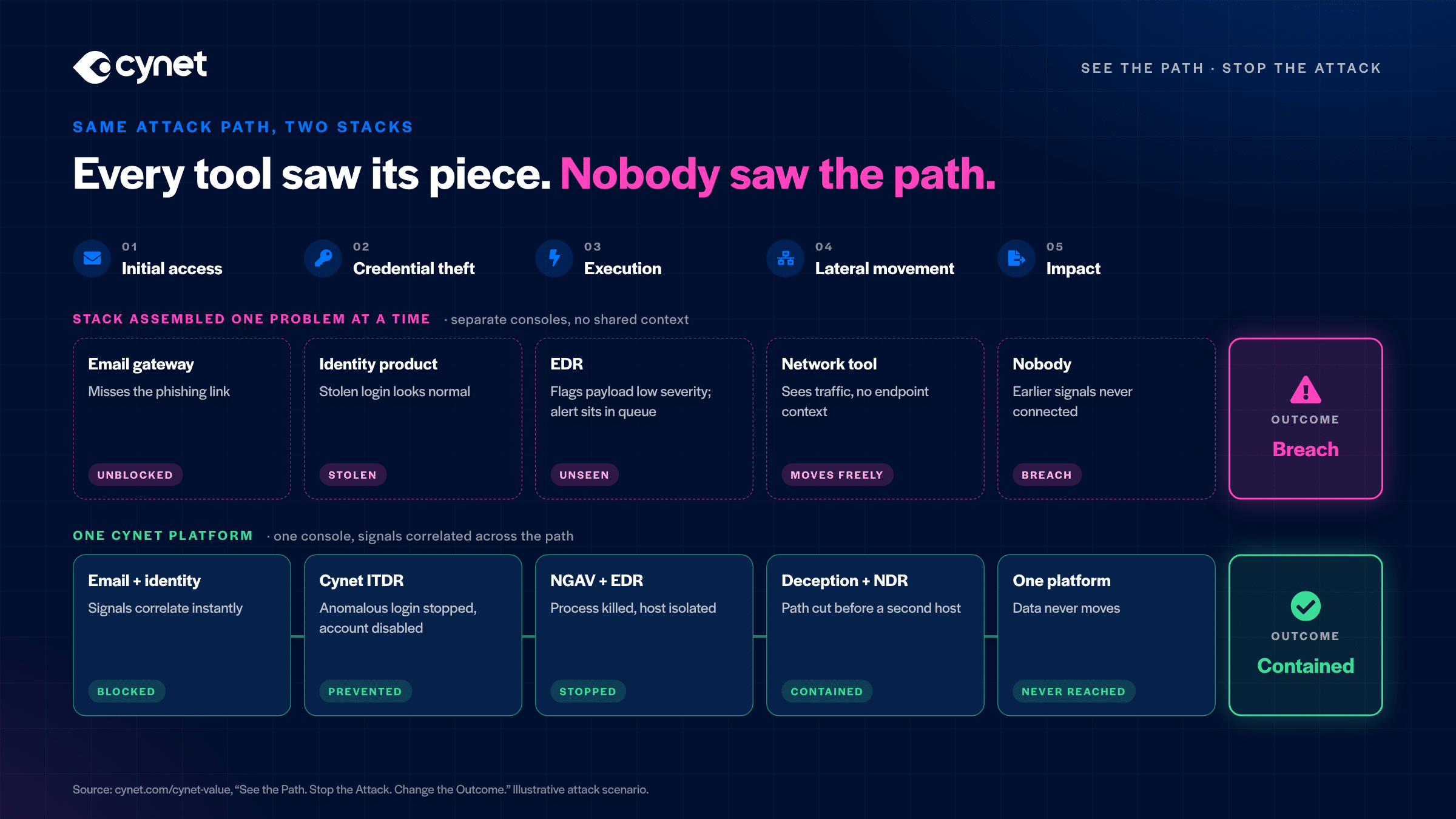
A modern intrusion rarely stays in one place. It starts with a phishing email, turns into a stolen credential, lands on an endpoint, moves laterally across the network, reaches into SaaS apps, and ends with data leaving the environment.
In a stack assembled one problem at a time, each of those steps belongs to a different tool. Each tool may even see its piece. The email gateway logs the message. The identity product records a login. EDR flags a process as low severity. The network tool sees unusual traffic. But those signals live in separate consoles with no shared context, and nobody connects them until the incident is already a breach.
The gaps between tools are where attackers operate, and they know it.
What today’s attacks count on
When I look at how attacks succeed now, two things come up again and again: speed and breadth.
Speed. Attackers move from initial access to the next stage quickly, often faster than a lean team can triage a single alert queue. When correlation depends on someone pulling logs from three dashboards and lining them up by hand, the attacker is already a step ahead. Response time measured in hours is response time the attacker gets to use.
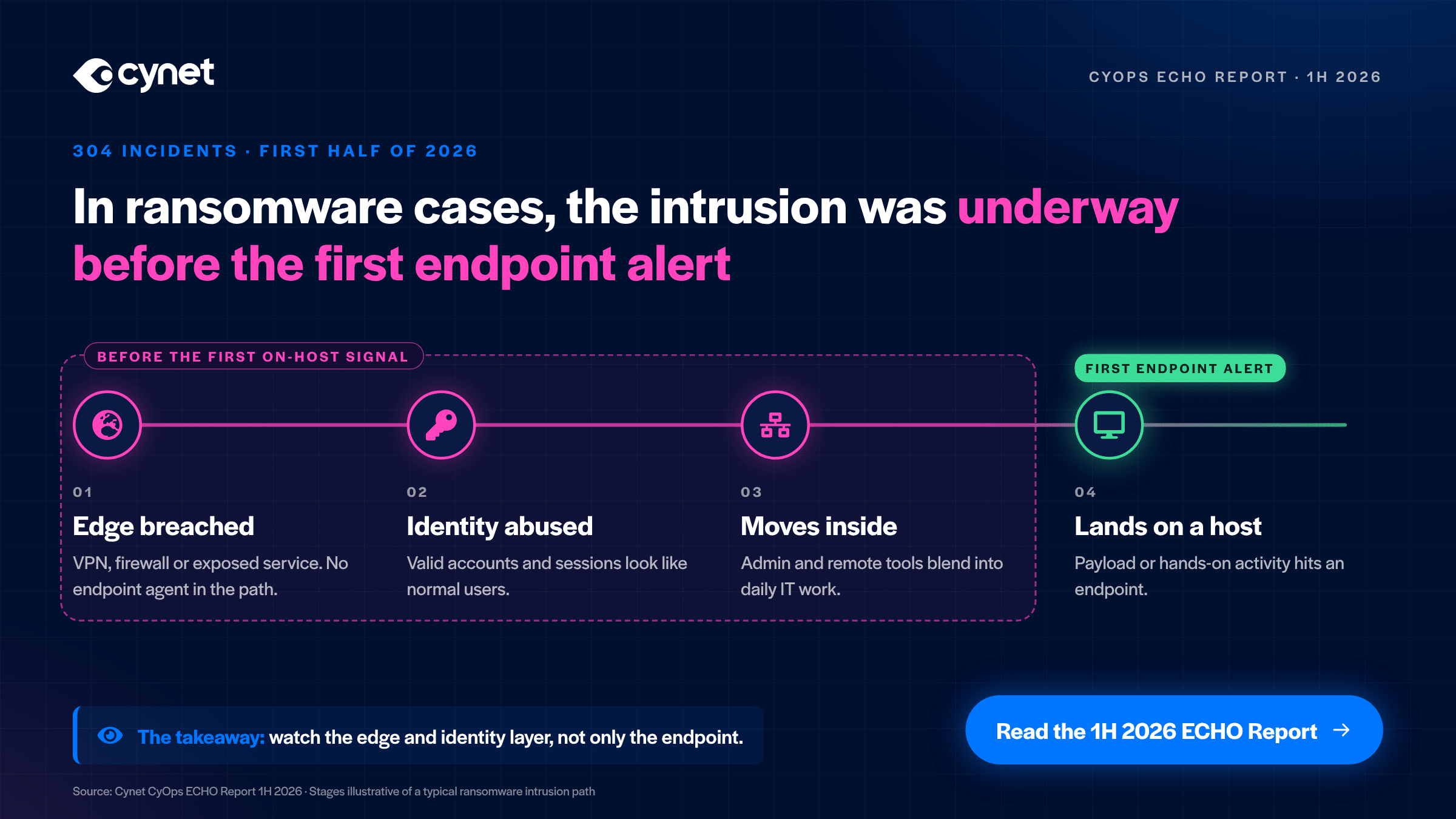
Our own CyOps data bears this out. In the 1H 2026 CyOps ECHO Report, built from 304 incidents our team handled in the first half of the year, attackers in ransomware cases had often made it past the network edge before the first on-host signal could fire. By the time an endpoint tool raised its hand, the intrusion was already well underway.
Breadth. Attacks deliberately cross surfaces. An identity compromise becomes an endpoint problem, which becomes a network problem, which becomes a data problem. Every handoff between tools creates a seam, and every seam is a place where a signal can get dropped.
A stack built one surface at a time struggles with both. It has breadth on paper, spread across separate products, but it rarely has speed, because the context needed to act fast is scattered.
Covering both
This is the problem Cynet is designed around. On breadth, one platform covers endpoint, identity, AI, network, email, and SaaS, so the whole attack path is visible in one place instead of in five fragments. On speed, CyAI correlates signals across those layers as they happen and triggers automated response the moment a path starts to form, so containment happens in seconds instead of after hours of manual triage. CyOps, our 24×7 MDR team, backs that up when a human needs to weigh in.
In practice, the same attack plays out very differently. Phishing is blocked at the click. An anomalous login is stopped and the account disabled. A malicious payload is killed and the host isolated. Lateral movement is cut off before a second machine is touched. The data never moves.
See it against your own stack
We built the Cynet Value page to make this concrete. You select the tools you run today, and it shows which layers of the attack path have no active defense and how much residual risk remains because those tools don’t correlate with each other. It’s an illustrative model, not an assessment, but it’s a useful way to see your stack the way an attacker might.
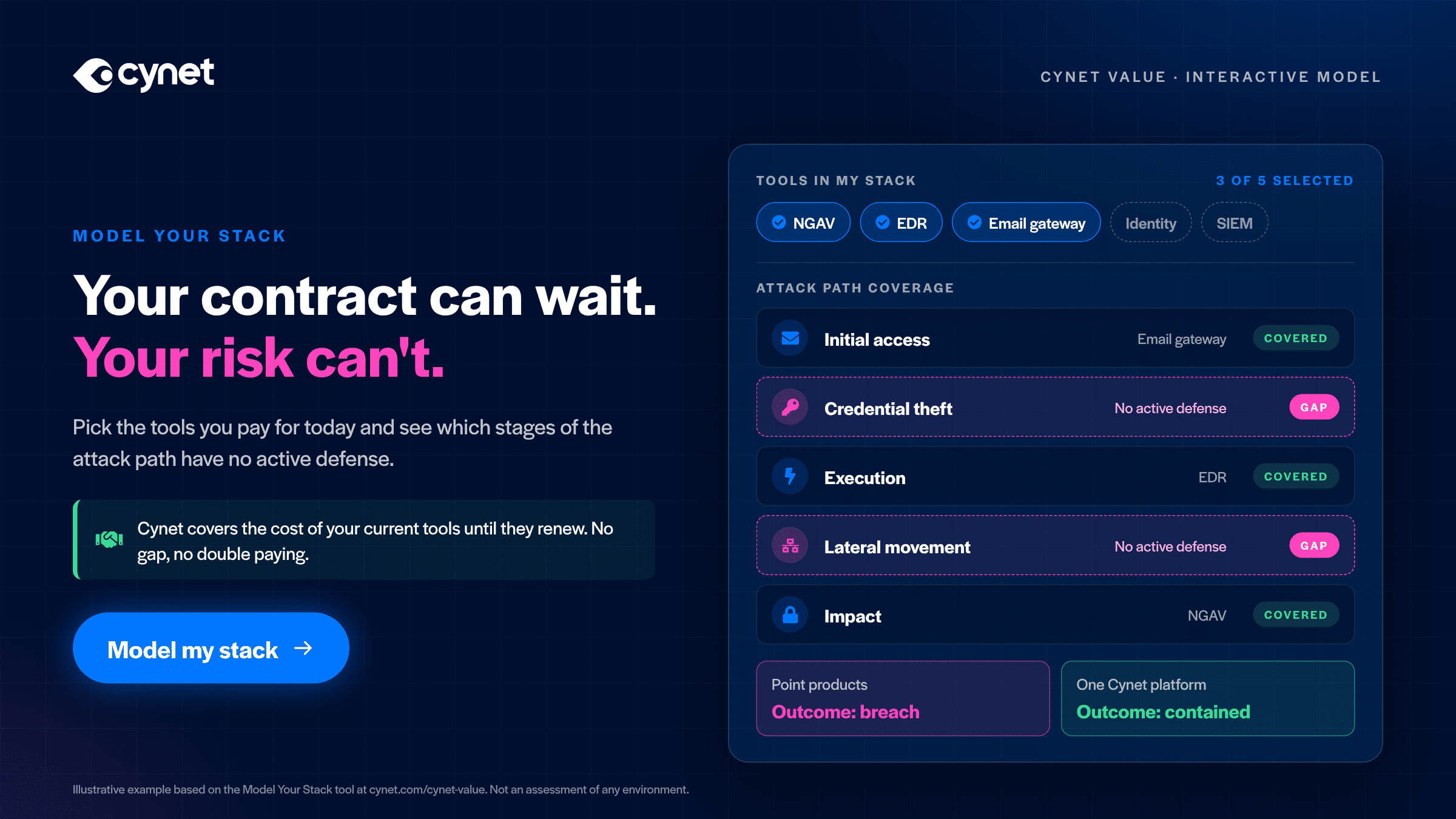
And since contracts are usually what keeps teams where they are, the page also explains how Cynet covers the overlap with your current tools until they renew.