

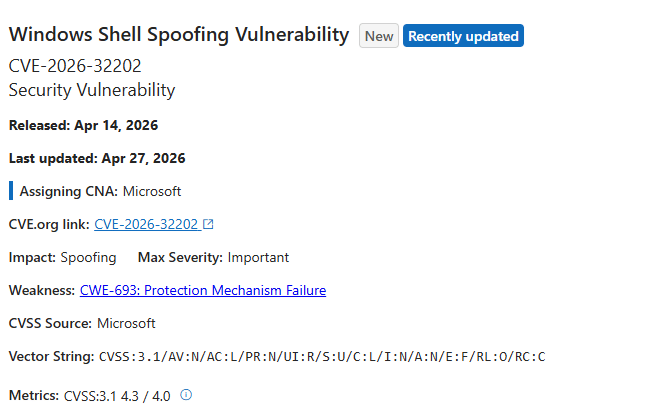
CVE-2026-32202 is a Windows Shell spoofing vulnerability addressed by Microsoft in the April 2026 Patch Tuesday update. Microsoft later revised its advisory to confirm that the vulnerability has been actively exploited in the wild.
Cynet Analysis
Cynet helps organizations reduce risk from CVE-2026-32202 by providing layered visibility, detection, prevention, and response across the exploitation chain and the post-exploitation activity that may follow.
Cynet Research and CyOps teams are actively monitoring and investigating CVE-2026-32202, including exploitation techniques and related attacker behavior. Cynet CyOps provides 24/7 monitoring of customer environments and hunts for suspicious activity that may indicate exploitation, credential theft, lateral movement, or follow-on compromise.
Cynet’s unified, AI-powered platform helps security teams identify suspicious behavior related to CVE-2026-32202, including:
- Malicious or suspicious .LNK file activity
- Abnormal Windows Shell or Explorer behavior
- Credential abuse and identity misuse
- Lateral movement and persistence attempts
- Post-exploitation activity across endpoint, network, identity, and SaaS environments
Recommended Actions and Best Practices:
- Organizations should immediately apply Microsoft’s April 2026 Patch Tuesday
- Review affected Windows assets listed by Microsoft/NVD.
- Restrict unnecessary outbound SMB traffic where operationally possible.
Executive Timeline:
- January 2026: APT28 exploits CVE-2026-21510 by dropping malicious LNK through Word.
- February 2026: Microsoft patched the original RCE and SmartScreen bypass chain tied to CVE-2026-21510.
- Akamai discovers that Microsoft’s patch for CVE-2026-21510 is incomplete, leading to CVE-2026-32202.
- April 14, 2026: Microsoft released the April Patch Tuesday update addressing the remaining issue as CVE-2026-32202.
- April 27, 2026: Microsoft updated the advisory metadata to confirm active exploitation and correct exploitability/CVSS details.
Understanding the CVE-2026-32202 Exploitation Path
CVE-2026-32202 should be understood in the context of the earlier Windows Shell vulnerability CVE-2026-21510.
CVE-2026-21510 was associated with a malicious .LNK exploitation chain in which Windows Shell processing could be abused to reference remote content over SMB. That behavior enabled a more severe attack path involving SmartScreen bypass and remote code execution.
Microsoft’s February 2026 update addressed the remote code execution and SmartScreen bypass components of that chain. However, the update did not fully remove the underlying condition that allowed Windows to initiate outbound SMB authentication while resolving a remote path referenced by a .LNK file.
That remaining behavior is now tracked as CVE-2026-32202. Unlike CVE-2026-21510, CVE-2026-32202 is not primarily a remote code execution issue. Instead, it is an authentication coercion issue that may cause a victim machine to authenticate to a threat actor-controlled SMB server, potentially exposing the victim’s NTLM hash.
In a potential abuse scenario, a threat actor delivers a malicious .LNK file to a victim. When Windows Shell processes the shortcut, the system may attempt to resolve a remote SMB resource controlled by the threat actor. This can trigger an NTLM authentication attempt and expose credential material without the threat actor needing to execute code on the endpoint.
LNK-Based NTLMv2
Credential Theft via SMB Forced Authentication
Figure 2: Potential abuse scenario of CVE-2026-3220
The diagram below illustrates a potential credential-theft path associated with CVE-2026-32202. In this scenario, a threat actor delivers a malicious .LNK file to the victim. When the victim opens the directory containing the shortcut, Windows Explorer may automatically parse the .LNK file. As part of that process, Windows may attempt to resolve a remote SMB path controlled by the threat actor, triggering outbound authentication and potentially exposing the victim’s NTLM hash.
The threat actor may then attempt to use the captured hash for NTLM relay, offline cracking, credential abuse, or other follow-on activity that could help expand access within the environment. In some cases, exposed credential material such as NTLM hashes may also be shared, traded, or reused by other threat actors, increasing the risk of broader compromise and additional intrusion attempts.
This behavior remained possible because Microsoft’s initial fix addressed the remote code execution and SmartScreen bypass chain but did not fully eliminate the SMB authentication coercion path. As a result, auto-parsed .LNK files could still trigger outbound authentication, preserving a zero-click credential-theft vector.
Why the Risk Goes Beyond a Medium CVSS Score
Microsoft classifies CVE-2026-32202 as a Windows Shell spoofing vulnerability caused by a protection mechanism failure, while public research highlights its practical impact as NTLM credential exposure. This matters because exposed NTLM hashes can potentially be used for NTLM relay, offline cracking, credential abuse, or lateral movement, especially in environments where NTLM is still enabled or outbound SMB traffic is not tightly restricted.
Cynet Coverage for CVE-2026-32202-Related LNK Activity
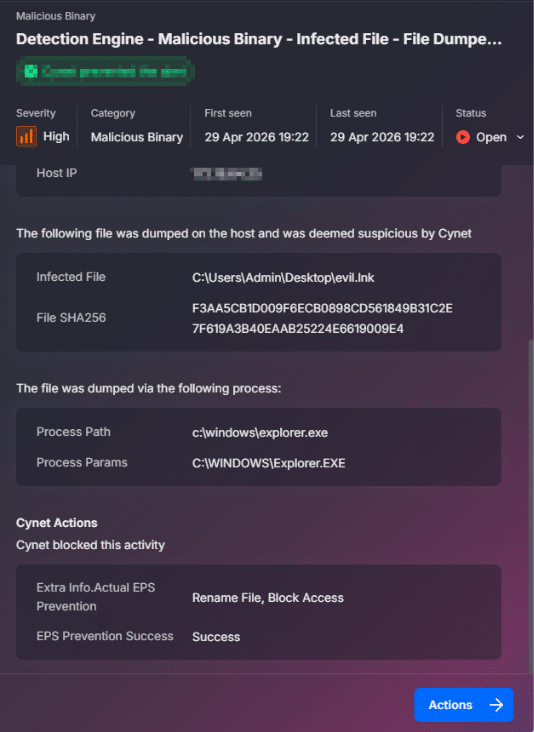
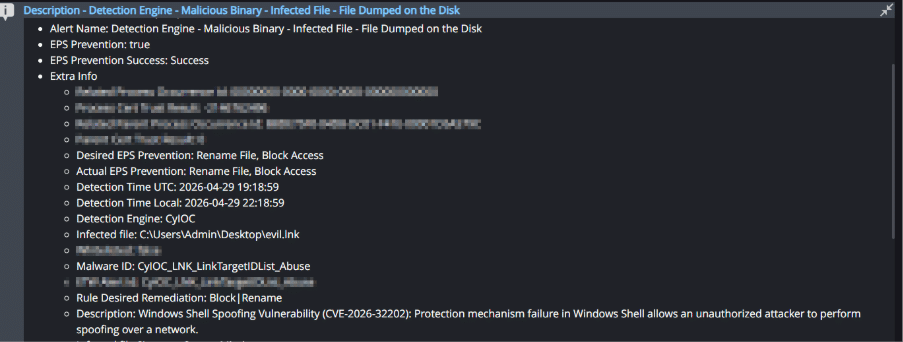
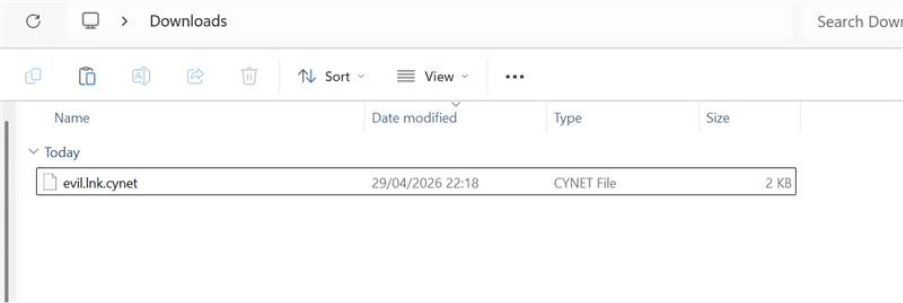
Cynet has deployed detections to help customers identify and mitigate activity associated with CVE-2026-32202, including malicious .LNK behavior, suspicious shortcut-file activity, remote SMB path references, abnormal outbound authentication, and related post-exploitation activity.

Strategic Outlook
While the critical remote code execution components of the original attack chain have been addressed, CVE-2026-32202 represents a significant shift toward industrialized credential harvesting. By exploiting the way Windows Shell resolves remote resources, threat actors can coerce authentication and capture Net-NTLMv2 hashes without executing a single line of code on the endpoint.
Research and CyOps teams are actively monitoring and investigating CVE-2026-32202, including specific exploitation techniques and related attacker behavior. To maintain a proactive defense, organizations should focus on hardening NTLM policies and restricting outbound SMB traffic to neutralize this persistent authentication-coercion path.
With the Cynet's unified, AI-powered platform, customers gain layered visibility and protection across endpoint, network, identity, and SaaS environments. Cynet combines behavioral logic, AI-based analytics, Zero-Trust-based controls, and CTI-driven detections to help identify exploitation attempts, credential abuse, lateral movement, and suspicious post-exploitation activity.