

Ransomware operations are built around a familiar playbook: get in, lock up critical systems, and hold decryption hostage until payment is received. Settra takes those classic tactics a step further by making the ransomware itself difficult to inspect, creating another barrier for researchers trying to understand how the campaign works.
During a recent CyOps incident response investigation, Cynet obtained a Settra ransomware payload that had been delivered to a victim environment. The ransomware engine was buried inside an encrypted blob and gated behind an operator-supplied password. Without the correct password, the executable simply terminated, leaving researchers and automated sandboxes with little to analyze.
But CyOps had something most researchers would not: the victim-specific password used by the attacker.
That allowed Cynet Research Labs to unlock the payload, reconstruct the full execution flow, recover the inner Windows encryptor, and examine Settra from the inside out. What we found was an enterprise-focused ransomware tool built to frustrate analysis, dismantle recovery options, erase forensic evidence, and encrypt data without communicating with attacker infrastructure during the encryption phase.
Settra hides the ransomware before it ever runs
One of the most notable findings was how aggressively Settra protects the encryptor itself.
The file delivered to the victim does not expose the full ransomware engine. Instead, the outer loader contains a roughly 1.4 MB encrypted blob, uses very few conventional imports, dynamically resolves Windows APIs, and performs a series of checks before proceeding.
Most importantly, Settra requires an operator-provided –pass value. If the parameter is missing, incorrect, or fails cryptographic validation, the loader exits. It also terminates if it detects an attached debugger. In several failure scenarios, it returns a normal-looking exit code, which can cause automated sandboxes to conclude that nothing interesting happened.
That password effectively acts as an anti-analysis gate around the ransomware. In this incident, CyOps acquired the password through the IR process. Once supplied, it passes through roughly 200,000 SHA-256 iterations to derive a key that decrypts the embedded payload with AES-256-CTR. Settra then validates a custom LP77 header and decompresses the data in memory to reveal the inner ransomware executable.
Importantly, the password does not decrypt the victim’s files. It unlocks the ransomware payload itself. A researcher who obtains a Settra sample may still be unable to inspect the encryptor without the corresponding execution secret.
Once unlocked, the inner ransomware is built for impact
Getting past the outer packer revealed a highly capable ransomware engine.
Before encryption begins, Settra:
- Powers down Hyper-V virtual machines so their virtual disks can be encrypted.
- Disables Windows Recovery Environment and other native recovery mechanisms.
- Deletes Windows Server Backup metadata and disables System Restore.
- Shrinks VSS shadow storage, forcing Windows to purge existing shadow copies.
- Clears 12 Windows event logs.
- Deletes Prefetch data and PowerShell command history.
- Clears the NTFS USN change journal.
- Uses Windows Restart Manager to terminate processes holding files open.
The Hyper-V behavior is particularly telling. Settra identifies running virtual machines and powers them down so .vhd, .vhdx, and related files are no longer locked by the hypervisor and can be encrypted.
It also deliberately removes many of the artifacts incident responders would normally use to reconstruct what happened while degrading the victim’s ability to roll systems back. This is not ransomware racing straight to encryption; it is an impact tool designed to leave defenders with fewer options after detonation.
The encryptor does not exfiltrate victim data
Another important finding came from what the payload doesn’t do.
Settra’s ransom note claims that large volumes of corporate data have already been stolen. But our reverse engineering found no capability inside the encryptor itself to upload files to attacker infrastructure.
There is no WinHTTP or WinINet client, Winsock-based upload stack, cloud-storage integration, or other file-transfer mechanism. The network functionality present in the binary is limited to Windows APIs used to access SMB shares for encryption.
That tells us something important about Settra’s operating model:
Data theft and ransomware deployment are separate phases of the intrusion.
By the time the encryptor appears, exfiltration is expected to have already occurred. Seeing no suspicious outbound connection from the ransomware binary does not mean data was not stolen. Exfiltration may have happened hours or days earlier through VPN access, remote-management tooling, cloud-storage utilities, or other attacker-controlled channels.
The locker is the final impact mechanism, not the entire attack.
Settra keeps the decryption secret offline, too
Settra follows the same separation principle with encryption.
For each file, it generates a symmetric encryption key locally, then wraps that key using an embedded 4096-bit RSA public key. The corresponding RSA private key is never present on the compromised machine, and there is no C2 connection used to upload encryption keys.
Everything needed to encrypt files is already inside the payload, while the secret required for decryption remains under attacker control. Cutting Settra off from the network once encryption begins therefore does not stop it from encrypting local or accessible network files.
The ransom note reveals a broader extortion strategy
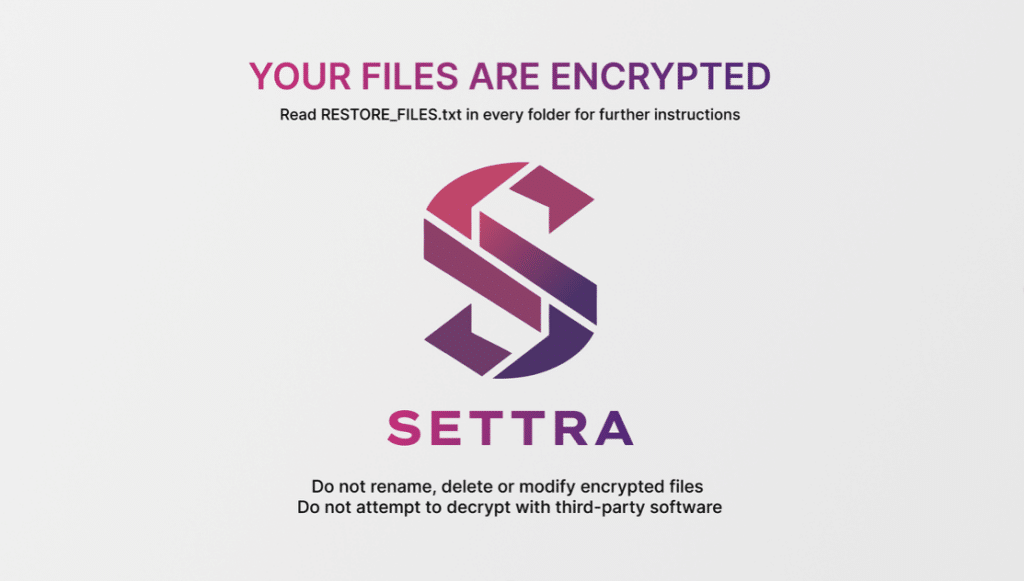
Recovering the inner payload also gave researchers visibility into Settra’s complete ransom note.
The note tells victims that data has already been uploaded, backups have been destroyed, systems are unavailable, and stolen information may be published. It directs victims to a private Tor negotiation room and warns against taking recovery actions without engaging the attackers.
It even discourages working with outside recovery companies. The message is designed not only to demand payment, but to influence how the victim responds to the incident. That reflects how ransomware extortion has evolved beyond a simple exchange of decryption for payment into an effort to control the victim’s technical, operational, and communications response.
What Settra tells us about modern ransomware
Settra is interesting because of its combination of classic ransomware tactics: encryption, obfuscation, anti-analysis, process hollowing, defense evasion, anti-forensics, and recovery destruction. Together, they make the payload harder to inspect and the attack harder to recover from.
Those behaviors reinforce several lessons for defenders.
First, the ransomware binary is not the beginning of the incident. By the time Settra is deployed, attackers may already have valid credentials, persistent remote access, stolen data, lateral movement across the environment, and impaired security tooling. The observed intrusion chain includes compromised VPN or domain credentials, credential dumping, PAExec or NetExec, remote-management tooling, and BYOVD techniques intended to disable defenses before encryption.
Second, network monitoring alone is not enough to stop the final impact. Settra does not need to beacon out for keys or transmit victim data while encrypting. Behavioral detection at the endpoint becomes critical once the attack reaches this stage.
Third, local forensic evidence cannot be assumed to survive. Settra deliberately clears logs, histories, Prefetch records, and the USN journal. Forwarding telemetry off-host in real time gives responders evidence the malware cannot easily erase.
Finally, recovery architecture matters just as much as detection. Settra interferes with Windows recovery, backup metadata, shadow copies, and virtualization workloads. Immutable or otherwise isolated backups with separate credentials remain essential.
Catching the behavior when the payload is designed to stay hidden
Settra illustrates the limitations of relying exclusively on signatures, hashes, or sandbox detonation. A fresh sample can be unsigned, encrypted, password-gated, and effectively inert without the exact parameters supplied by the attacker.
But once ransomware begins behaving like ransomware, the situation changes.
During Cynet testing, the platform detected Settra as it attempted unauthorized file operations against decoy files and terminated the malicious process within approximately one second. No production user files were encrypted in Block Mode.
That is the larger lesson from Settra. Attackers can encrypt payloads, hide APIs, hollow processes, require passwords, erase logs, and keep encryption keys offline. But ransomware still has to interact with the system it wants to disrupt. That behavior gives defenders another opportunity to stop it.
For the full technical breakdown of Settra, including reverse engineering, execution flow, IOCs, MITRE ATT&CK mapping, and Cynet detection telemetry, read the complete Cynet Research Labs investigation.