Today’s threat landscape makes one thing clear: security incidents are no longer rare events… they’re inevitable. From phishing and ransomware to insider threats, every organization will face a moment where its defenses are tested and challenged. The difference between chaos and control often comes down to preparation. That’s where an incident response policy becomes critical. It provides structure, clarity, and the speed needed to contain threats, reduce damage, and guide recovery. A strong policy outlines scope, defines roles and responsibilities, sets communication protocols, and ensures regulatory compliance. In short, it gives organizations a clear roadmap to follow when the stakes are high.
In this article, we’ll walk you through everything you need to build an effective incident response policy for your organization or your clients.
An incident response policy is a critical document that outlines the structured approach an organization follows when responding to and managing a cybersecurity incident. This policy serves as a roadmap for the Incident Response Team, detailing the composition of the team, the particular responsibilities of each member, and the protocols for communicating during an incident. It specifies the strategies for utilizing tools and techniques to address and mitigate security breaches and establishes a clear chain of command, ensuring that there is no ambiguity about who is responsible for overseeing the enforcement of the policy.
By setting these guidelines, an organization ensures that it can react swiftly and effectively to security incidents, minimizing potential damage and facilitating a speedy recovery.
An effective incident response policy allows the team to act during an incident in a calm, effective, and methodical manner. To do so, it should outline clear structures, responsibilities, and processes. Here are the core components to include:
Ensure all stakeholders recognize what the policy aims to accomplish, the context in which it applies, and how it safeguards the business.
By clearly assigning roles, organizations foster accountability, eliminate ambiguity, and accelerate decision-making during security incidents.
Typical team members include:
A standardized taxonomy of incidents ensures consistent responses and reduces confusion due to communication issues. Definitions typically include the security event, security incident, and severity levels.
Defined reporting and communication flows streamline coordination, speed up resolution, and ensure incidents are managed efficiently.
Protocols include:
Practical step-by-step guides keep teams focused, reduce errors under pressure, and ensure every critical phase of incident response is executed.
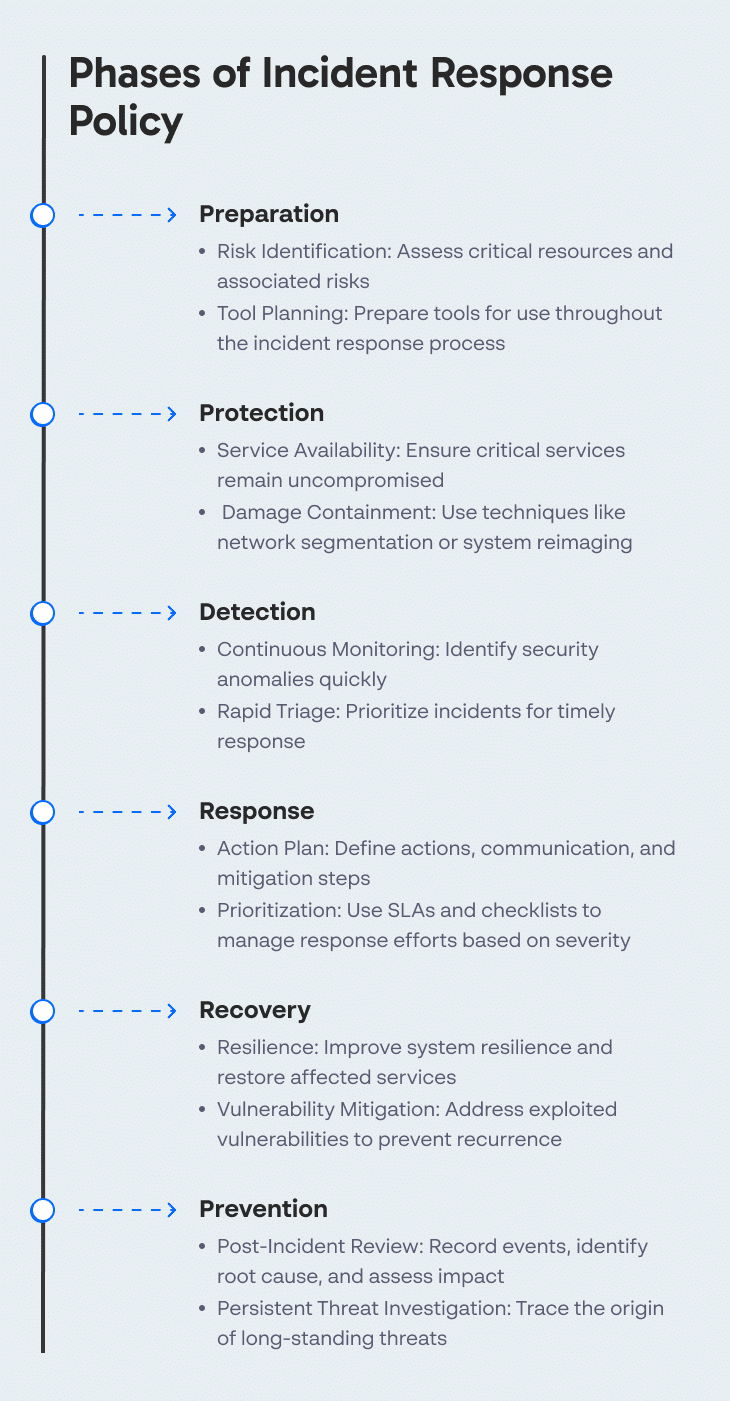
An incident response policy should cover at least the following six phases:
Incident Response Quick Guide
An effective incident response policy helps lean organizations quickly detect, respond to, and recover from cybersecurity incidents while minimizing disruption and damage. The following six phase framework provides a clear, step-by-step approach that covers preparation, protection, detection, response, recovery, and prevention
| Phase | What to Do | Outcome |
| Preparation |
|
Ready to act with clear roles and define potential risks |
| Protection |
|
Business continuity, minimal disruption |
| Detection |
|
Rapid detection, reduced delays |
| Response |
|
Fast, consistent, effective response |
| Recovery |
|
Systems restored, resilience improved |
| Prevention |
|
Stronger defenses, fewer future incidents |
For more detailed information, The Incident Response Process
The following tips will help you define a more effective incident response policy.
Update Policies Regularly
Incident response policies should be regularly revised to keep up with new cybersecurity technologies, techniques, and threats facing the organization. The policy should be broad enough to cover all likely incidents, with lessons learned from specific events incorporated into the relevant sections.
Keep Policies Clear and Concise
Policies should be easily digestible to IT staff, security personnel, engineers, legal advisors, and executives. Avoid overly technical jargon. It is also recommended to use visual aids like: flowcharts, videos, RACI metrics, etc.
Train Regularly
Regular tabletop exercises help prepare for real-world scenarios without the chaos of an actual breach. This helps identify gaps in procedures, communication breakdowns, and resource limitations, so they can be amended before real incidents. Simulations should vary in complexity and scope, from simple phishing incidents to complex multi-vector attacks involving data exfiltration and system compromises.
Assign Clear Ownership
Define clear owners and roles for all incident stakeholders. This includes incident response managers, IT/Systems teams, forensic analysts, communications personnel, legal counsel, ops, and executive leadership. This prevents the “too many cooks in the kitchen” syndrome that can paralyze response efforts when multiple stakeholders attempt to direct remediation activities simultaneously, or, on the other hand, important activities fall between the cracks due to a lack of ownership.
Involve Stakeholders in Planning
The successful creation and implementation of incident response strategies requires close collaboration between departments. Responding to large-scale incidents, especially those with financial consequences, requires the involvement of legal teams, public relations, human relations, customer support, senior management, and more.
All relevant stakeholders, both internal and external, should participate in incident response policy planning. By allowing all stakeholders seat at the table, your organization is more likely to capture the relevant steps to take in a real event and ensure closer cooperation with stakeholders when a breach occurs.
For example, early legal integration defines the scope of external counsel involvement, helping establish privilege protections for incident response communications, and creates clear guidelines for evidence preservation that can withstand legal scrutiny.
Related content: read our guide to building an incident response team.
Define Severity Levels and Escalation Paths
Don’t treat every event as a full-blown crisis. Define what counts as a low, medium, or critical incident. Link severity to specific playbooks and escalation paths. Think along the lines of who gets notified, how quickly, what resources are deployed, and which actions to take.
Continuously Monitor Performance
Use the following metrics to monitor the performance of your organization’s incident response team:
Incident Response Automation
Cynet provides a holistic solution for cybersecurity, including Cynet Response Orchestration which can automate your incident response policy. Users can define automated playbooks, with pre-set or custom remediation actions for multiple attack scenarios.
Cynet Response Orchestration can address any threat that involves infected endpoints, malicious processes or files, attacker-controlled network traffic, or compromised user accounts.
Learn more about Cynet Response Orchestration.
Incident Response Services
Cynet provides Incident Response (IR) services that add deep security experience to its world-class incident response platform. Cynet’s proactive 24/7 security team acts as your extended team, identifying incidents, leading any required analysis, and responding on your behalf. Our incident response services provide:
In my experience, here are tips that can help you better adapt to implementing an effective incident response policy:
An incident response service can assist an organization in detecting, responding to, and mitigating cybersecurity threats. In its basic form, service providers are paid a retainer or per-incident fee, and respond to high-profile breaches within a timeframe dictated by a Service Level Agreement (SLA).
Incident response services can also address ongoing minor incidents, remove ransomware, malware, and the like, and hunt for existing or potential threats or vulnerabilities. Most providers follow through with post-breach investigations.
The framework for how an organization detects, manages, and recovers from security incidents. It defines the purpose, scope, and principles guiding response efforts, ensuring that everyone understands their role and which actions to take when a breach or disruption occurs.
The CISO or equivalent security leader as they are responsible for the organization’s overall security posture. Buy-in should also come from executive leadership.
Purpose and scope, roles and responsibilities, escalation paths, communication strategies, incident definitions, playbooks and checklists, and a review/revision schedule.
The policy sets the overarching rules, scope, and authority. It provides direction, accountability, and compliance alignment. An incident response plan is more tactical, focusing on “how” the organization will achieve the policy’s goals, step-by-step.
An actionable tool that responders can follow during high-pressure situations. It typically includes verification steps, containment actions, notification requirements, escalation paths, and post-incident review tasks.
An incident response policy ensures the organization meets regulatory obligations. For example, breach notification deadlines, evidence preservation, communications requirements, and disclosure scope.
At least annually, but more frequently if new threats, technologies, or regulatory changes emerge. Organizations should also update the policy after significant incidents or following lessons learned during tabletop exercises.



Search results for: