Incident response management enables organizations to prepare and respond to security incidents in an effective, thought-out, and resourceful manner. In the detailed guide below, we explain the key elements of an incident response management plan, best practices for incident response management, which tools to use, and expert tips. After reading this article, you’ll be able to better automate and strengthen your incident response management efforts.
Incident response management is a systematic strategy that allows an organization to address cybersecurity incidents and security breaches. The goal of incident response is to identify real security incidents, get the situation under control, limit the damage caused by an attacker, and reduce the time and costs of recovery.
Incident response management typically includes formal documentation describing incident response procedures. These procedures should cover the entire incident response process, including preparation, detection, analysis, containment, and post-incident cleanup. By following these procedures, organizations can limit damage, prevent further losses, and comply with applicable compliance regulations.
The following are the primary elements of an incident response management program: an incident response plan, a team responsible for incident response, and tools used to facilitate and automate stages of the process.
An incident response plan should specify in detail how your team should perform the following incident response stages, who is responsible for what, and what documentation and notifications are necessary:
Learn more in our detailed guide to incident response plan
Incident response teams typically include the following roles. Each role should be clearly informed of their responsibilities in the event of a security incident:
External security forensics experts – Brought in for complex incidents. They perform deep-dive forensics, assist with incident reconstruction, and validate internal findings.
Learn more in our detailed guide to incident response teams
To be effective, modern security organizations use technological tools to detect and even automatically respond to security incidents. The following security tools can be leveraged by incident response teams if they are present in the organization’s environment:
Related content: read our guide to incident response platforms
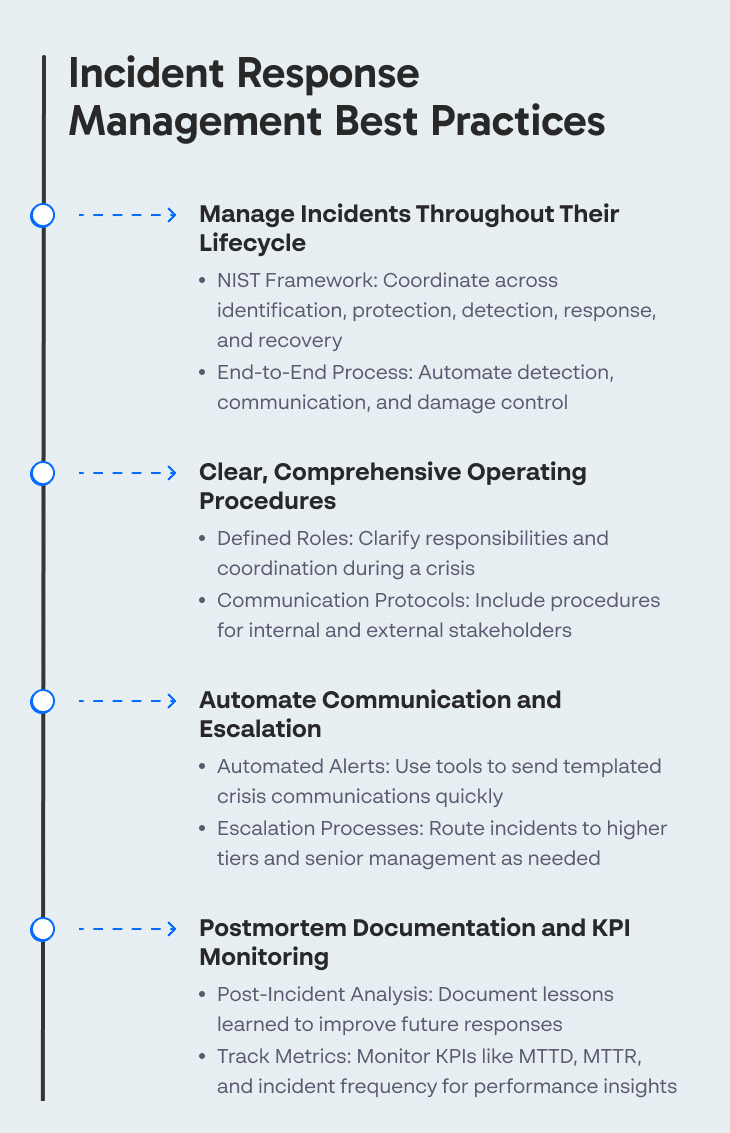
Here are several best practices that can help you make your organization’s incident response management program more effective.
According to the NIST framework, the cybersecurity lifecycle includes five areas: identification, protection, detection, response and recovery. An effective incident response management program must coordinate and automate the entire process—from initial detection of an incident to communication, damage control, and lessons learned after an incident has been contained.
Robust incident response management helps security teams stay calm and take the necessary action while the organization is under attack. An important advantage of an organized incident response management process is that it is immediately clear what needs to be done in the early stages of a crisis. Incident response procedures clarify who is responsible for coordinating all resources in the most effective way possible to mitigate the threat.
In addition to technical personnel, the plan should include clear risk management and communication procedures. It should be clear who can speak on behalf of the organization and what they should communicate. There should be procedures for informing lawyers, insurance companies and other relevant internal or external stakeholders.
When a security breach occurs, the organization’s reputation can be seriously affected. It is very important to instruct employees how to communicate in a crisis situation. Automated communication tools allow teams to focus on solving high-priority problems without wasting valuable time during the crisis.
For example, automated communication can take the form of an automated email system that sends templated messages to all relevant parties, based on incident information provided by the response team. Another direction for automation is event escalation—depending on the severity of an event, it can be communicated to higher analyst tiers in the security organization, and if necessary, to other departments and senior management.
Postmortem analysis and documentation, after a security incident has ended, is an important part of effective incident response management. It allows employees to turn crisis events into an organization-wide learning experience.
Periodically, the incident response team should perform an analysis of incident response activities and record metrics like the number of incidents per month, mean time to detection (MTTD) and mean time to resolution (MTTR), and downtime rates for affected systems. Tracking these and other relevant metrics over time can indicate the success of the incident response process.
In my experience, here are tips that can help you better adapt to incident response management:
An incident response process covers the entire incident investigation lifecycle, including the following stages:
Incident management is a broader term that encompasses the entire lifecycle of an incident, from preparation to detection to resolution and documentation. Incident response, on the other hand, is a more focused discipline that specifically deals with an incident in real-time. It zeroes in on detecting, analyzing, containing, eradicating, and recovering from malicious attacks or breaches.
Many organizations struggle with alert fatigue, where security teams are overwhelmed by the volume of alerts, many of which are false positives. This can lead to real threats being missed or not acted upon quickly enough. Another major challenge is coordination and communication during a live incident. In high-pressure situations, poor communication can lead to missteps, such as improper containment measures, data loss, or public relations fallout. Finally, many organizations lack preparation, like updated incident response playbooks or practicing response procedures, which slows down decision-making and increases the risk of mismanagement.
An Incident Response Team, also known as the Cyber Incident Response Team (CSIRT), is a group that can include dedicated full-time staff, part-time staff, and third-party vendors. The team is responsible for:
To properly prepare and respond to incidents across your business, your organization must have an incident response team, or an outsourced incident response team from a managed security service provider (MSSP) or managed detection and response (MDR) provider.
Whether in-house, outsourced, or a mix of both, incident response teams include security analysts, engineers, threat researchers, and an incident response manager who is ultimately responsible for managing severe incidents. They work closely with other departments including communications, legal, and human resources.
Incident response tools can automate repetitive tasks and accelerate threat detection and triage. They can aggregate logs, detect anomalies, and correlate data across the network in real time. This helps teams quickly identify the root cause of an incident and reduces the manual effort required to investigate threats. Automation also ensures that standard response actions can be executed rapidly, minimizing potential damage. In addition, these tools improve collaboration and consistency across teams. This minimizes confusion during a crisis and helps with efficient decision-making.
For small security teams, the best incident response tools are those that offer strong automation, intuitive interfaces, and all-in-one capabilities, reducing the need for manual analysis and multiple point solutions. Tools like Cynet are particularly well-suited for small to mid-sized teams because they combine endpoint protection, detection, and automated response in a single platform. Cynet also includes a 24/7 MDR service, which is valuable for small teams without round-the-clock coverage.
KPIs like Mean Time to Detect (MTTD), Mean Time to Respond (MTTR), and Mean Time to Contain (MTTC) are commonly used to evaluate how quickly your team identifies, analyzes, and mitigates threats. Additionally, track the number of false positives, repeat incidents, and successful containment efforts. On the qualitative side, post-incident reviews and tabletop exercises can provide valuable insights for continuous improvement.
Incident response procedures should be reviewed and updated at least annually, but more frequent updates are recommended when significant changes occur in your IT environment, threat landscape, or organizational structure. In addition, if you onboard new tools, adopt cloud services, undergo a merger or acquisition, or experience a major security incident, it’s highly recommended to reassess and revise your procedures right away to reflect those changes.
Incident Response Automation
Cynet provides a holistic solution for cybersecurity, including Cynet Response Orchestration which can automate your incident response policy. Users can define automated playbooks, with pre-set or custom remediation actions for multiple attack scenarios.
Cynet Response Orchestration can address any threat that involves infected endpoints, malicious processes or files, attacker-controlled network traffic, or compromised user accounts.
Learn more about Security Automation and Orchestration
Incident Response Services
Cynet provides Incident Response (IR) services that add deep security experience to its world-class incident response platform. Cynet’s proactive 24/7 security team acts as your extended team, identifying incidents, leading any required analysis, and responding on your behalf. Our incident response services provide:



Search results for: